
The real test begins after the opening bell rings—Grant Thornton: An IPO is not the finish line.
As published in Nanyang Siang Pau (12th September 2026) translated into English
For business founders, an initial public offering (IPO) is an important milestone in a company’s development and is often regarded as the greatest achievement of their entrepreneurial journey.
However, once the listing bell has been rung, the company must face not only matters of capital and valuation, but also higher compliance requirements, greater governance responsibilities, and continued pressure to operate and raise funds.
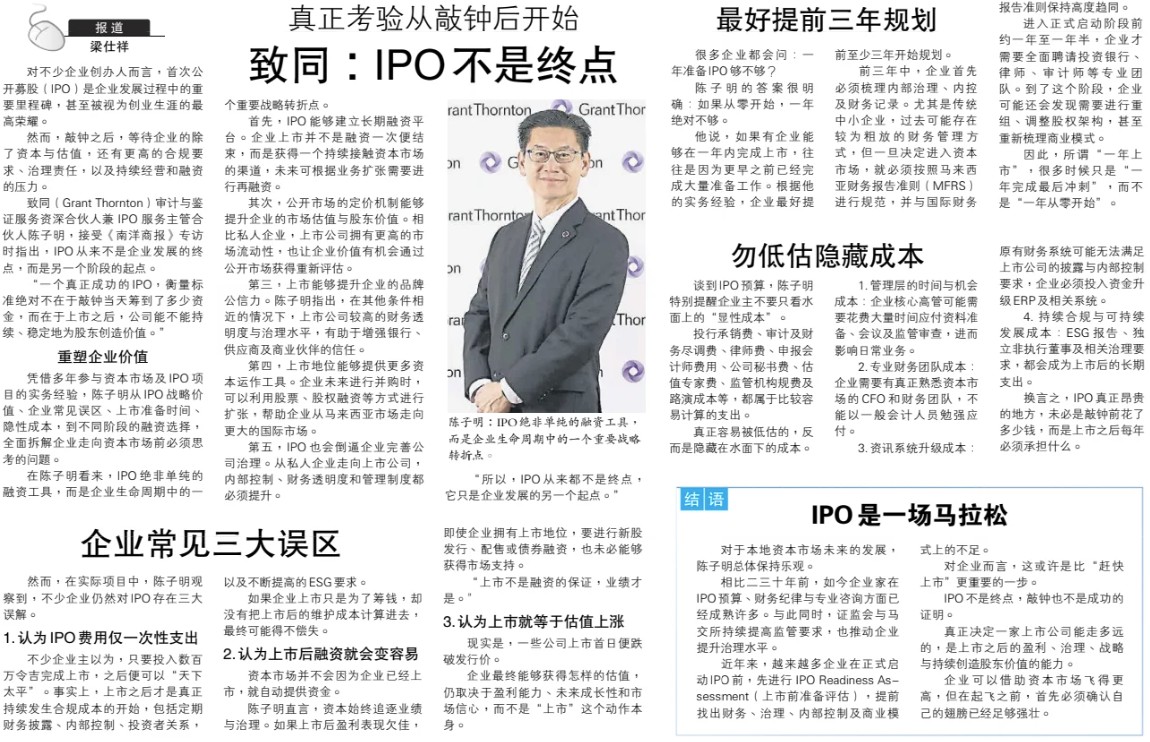
According to Desmond Tan, Senior Partner of Audit and Assurance and Head of IPO Services at Grant Thornton Malaysia, an IPO is never the end of a company’s development—it marks the beginning of a new phase.
“A truly successful IPO should not be measured by how much money was raised on the listing day. What matters is whether the company can continue creating stable and sustainable value for its shareholders after listing.”
Reshaping Corporate Value
Drawing on his extensive experience in capital markets and IPO projects, Tan explained the issues companies must consider before entering the capital market—from the strategic value of an IPO and access to financing to preparation time, hidden costs and financing options at different stages.
In his view, an IPO is not merely a fundraising tool. It is an important strategic turning point in a company’s life cycle.
First, an IPO establishes a long-term financing platform. Listing is not a one-off fundraising exercise; it gives a company continued access to the capital market and the ability to raise additional funds when required for expansion.
Second, public-market pricing can enhance a company’s valuation and shareholder value. Compared with private companies, listed companies generally have greater liquidity, allowing their value to be reassessed by the public market.
Third, listing can strengthen a company’s credibility and brand. When other conditions are similar, the higher financial transparency and governance standards of a listed company can improve confidence among banks, suppliers and customers.
Fourth, listing provides companies with more tools for capital management. For future mergers and acquisitions, companies can use shares and equity financing to support expansion from the Malaysian market into larger international markets.
Fifth, an IPO encourages companies to strengthen their corporate governance. When transitioning from a private company to a listed company, internal controls, financial transparency and management systems must all be improved.
“An IPO has never been the end. It is simply another starting point in a company’s development.”
Even with listed status, a company is not guaranteed market support when issuing new shares, undertaking placements or raising funds through bonds.
“A listing does not guarantee financing—business performance does.”
Three Common Misconceptions About IPOs
1. IPO costs are only one-off expenses
Many business owners believe that once they spend several million ringgit to complete a listing, they will have nothing more to worry about.
In reality, listing marks the beginning of continuous compliance costs, including periodic financial disclosures, internal controls, investor relations and increasingly demanding ESG requirements.
If a company lists solely to raise funds without considering the ongoing cost of maintaining its listed status, the disadvantages may eventually outweigh the benefits.
2. Financing becomes easier after listing
The capital market does not automatically provide funds simply because a company is listed.
Investors focus on performance and governance. If post-listing earnings are unstable, the management team changes frequently or governance is weak, the company may struggle to obtain market support despite its listed status.
3. Listing automatically increases valuation
In reality, some companies fall below their issue price on their first day of trading.
A company’s valuation ultimately depends on its profitability, future growth potential and market confidence—not simply on the act of becoming listed.
Ideally, Start Planning Three Years in Advance
Many companies ask whether one year is sufficient to prepare for an IPO.
Tan’s answer is clear: if a company is starting from scratch, one year is definitely not enough.
Companies that successfully list within one year are usually able to do so because they completed substantial preparation much earlier. Based on his practical experience, companies should ideally begin planning at least three years in advance.
During those three years, a company must first organise and strengthen its corporate governance, internal controls and financial records. Traditional small and medium-sized enterprises may previously have used less formal financial-management practices, but once they decide to enter the capital market, their reporting must comply with the Malaysian Financial Reporting Standards (MFRS) and remain closely aligned with international financial reporting requirements.
Approximately one to one-and-a-half years before formally beginning the IPO process, the company should appoint its investment bank, lawyers, auditors and other professional advisers. At this stage, it may discover that restructuring, changes to its shareholding structure or even adjustments to its business model are required.
Therefore, a “one-year listing” usually means spending one year completing the final stretch—not starting from zero and completing everything within one year.
Do Not Underestimate Hidden Costs
When discussing IPO budgets, Tan cautioned business owners against considering only the visible costs.
These include fees for issuing advisers, auditors, tax consultants, lawyers, reporting accountants, public relations advisers, company secretaries and valuation specialists, as well as regulatory charges and financing costs.
The expenses most easily underestimated are those hidden beneath the surface:
1. Management time and opportunity costs
Senior management may need to spend considerable time preparing documents, attending meetings and responding to regulatory reviews, potentially affecting daily operations.
2. Professional finance-team costs
A company needs a CFO and finance team that genuinely understand the capital market. It cannot rely solely on general accounting personnel.
3. Information-system upgrade costs
Existing financial systems may not meet the disclosure and internal-control requirements of a listed company. The company may need to invest in upgrading its ERP and related systems.
4. Ongoing compliance and sustainability costs
ESG reporting, the recruitment of independent directors and employee training will become continuing expenses after listing.
In other words, the true impact of an IPO is not only how much a company spends before ringing the bell, but what it must continue investing every year after listing.
Conclusion: An IPO Is a Marathon
Tan remains generally optimistic about the future development of Malaysia’s capital market.
Compared with 20 or 30 years ago, today’s entrepreneurs are considerably more knowledgeable about IPO rules, financial discipline and professional advice. At the same time, the higher regulatory expectations imposed by investment banks and Bursa Malaysia are encouraging companies to improve their governance standards.
In recent years, more companies have undertaken an IPO Readiness Assessment before formally beginning the listing process. This allows them to identify weaknesses in their finances, governance, internal controls and business models in advance.
For companies, this may be more important than simply trying to list as quickly as possible.
An IPO is not the end, and ringing the listing bell is not proof of success. What ultimately determines how far a listed company can go is its ability to deliver profits, uphold strong governance, execute its strategy and continue creating value for shareholders.
A company can use the capital market to fly higher—but before taking off, it must first ensure that its wings are strong enough.
Experts / Authors
-
 Desmond Tan Desmond Tan is the Senior Partner of Audit and Assurance and Head of China Business Practice in Grant Thornton Malaysia.
View Profile