
Tax experts see targeted relief for middle-income taxpayers in Budget 2027
As published in The Edge Malaysia, 10th October 2026 (link to article)
In an interview with The Edge Weekly, Alan Chung, President of the Chartered Tax Institute of Malaysia (CTIM) and Senior Executive Director at Grant Thornton Malaysia, shared his views on Budget 2027, including M40 tax relief, PTPTN deductions, tax compliance and green incentives.
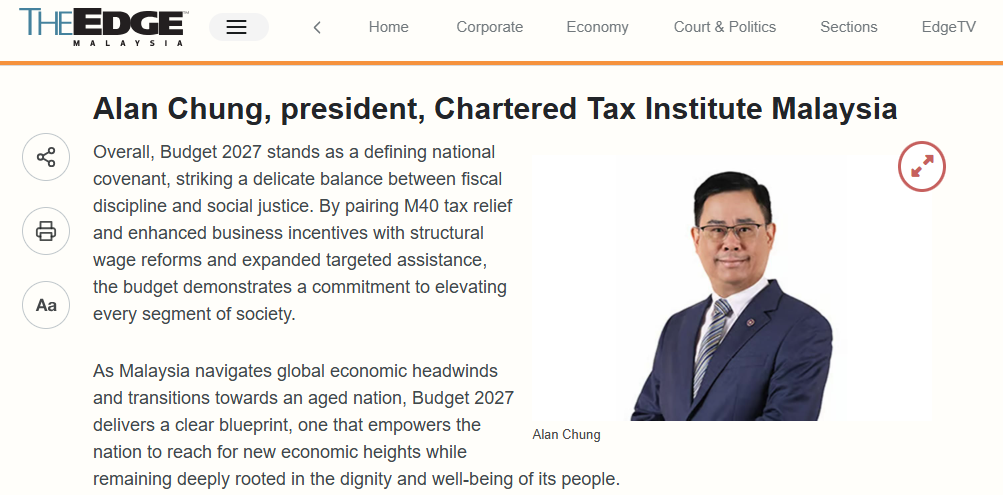
Excerpt from The Edge Malaysia:
Overall, Budget 2027 stands as a defining national covenant, striking a delicate balance between fiscal discipline and social justice. By pairing M40 tax relief and enhanced business incentives with structural wage reforms and expanded targeted assistance, the budget demonstrates a commitment to elevating every segment of society.
As Malaysia navigates global economic headwinds and transitions towards an aged nation, Budget 2027 delivers a clear blueprint, one that empowers the nation to reach for new economic heights while remaining deeply rooted in the dignity and well-being of its people.
Tax deduction will be given to employers who repay PTPTN education loans on behalf of their employees, covering repayments made from Jan 1, 2027 to Dec 31, 2028. This would encourage private sector participation in easing graduates’ education loan burdens.
Employees may benefit from reduced outstanding loans and improved disposable income, while employers receive tax incentives for supporting employee welfare. At the national level, the measure may encourage more consistent loan repayments and strengthen PTPTN’s financial sustainability, ensuring continued funding for future students.
Effective from the Year of Assessment 2028, companies other than MSMEs would be allowed tax deductions on salary expenses only where salaries are paid through financial institutions or prescribed cashless payment instruments, in accordance with the Employment Act 1955. Tax deductions for other expenses will remain unaffected by this requirement.
Payroll transparency would be enhanced, tax compliance would be strengthened and irregular employment practices would be discouraged.
Non-MSMEs are also likely to be discouraged from employing undocumented migrants where cash payments often prevail, and the employment of legitimate employees will be enhanced. The measure also supports the government’s broader efforts to promote cashless transactions and formalise employment practices.
The Green Technology Tax Incentive is enhanced and extended until Dec 31, 2030, supporting Malaysia’s ambition to achieve net-zero carbon emissions by 2050. The revised incentives introduce new qualifying activities, including ocean thermal energy conversion, and expand eligible assets to cover locally produced electric vehicle infrastructure, waste recycling systems and water conservation technologies.
Compared with the existing framework, the revised incentives adjust investment allowance rates across qualifying activities and prioritise integrated renewable energy systems combined with energy storage. Businesses investing in eligible green projects and assets may enjoy investment tax allowances of up to 100%, subject to applicable conditions. By promoting renewable energy, energy efficiency and domestic green technology manufacturing, Malaysia can strengthen energy security, attract sustainable investments and enhance its competitiveness in the global green economy.
Experts / Authors
-
 Alan Chung Alan Chung is the Head of Indirect Tax and Transfer Pricing. Alan is a Fellow of CTIM and a Fellow of CPA of Australia. He is currently the Deputy President of CTIM as well as the Chairperson of CPA Australia’s Malaysian Division Council’s Tax Committee. He was also formerly a Divisional Councillor for CPA Australia’s Malaysian Divisional Council. With a wealth of experience dealing with various government agencies and departments, Alan actively contributes in dialogues with various Government agencies to resolve a myriad of both direct and indirect tax issues.
View Profile