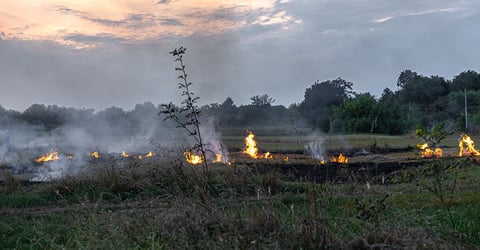
The haze keeps returning. Why?
To answer that question, we need to get to the root of the issue. Governments have not consistently enforced fire bans, clarified land ownership, protected peatlands, or held companies accountable for damage caused within or beyond their concessions.
The laws and policies exist. Enforcement often falls short.
Indonesia, the source of many regional haze episodes, prohibits land clearing by fire. Companies also publish sustainability policies, environmental commitments, and "zero-burning" pledges. Yet laws on paper do not automatically protect forests or communities.
Authorities must monitor vast and remote areas, determine who controls each parcel of land, and establish responsibility when fires occur. In many locations, agencies lack the staff, equipment, and funding needed to perform these tasks effectively.
Recent fire seasons have illustrated the challenge. During Indonesia's severe 2023 dry season, authorities reported thousands of hotspots and fires across several provinces, while Malaysia and Singapore once again experienced deteriorating air quality linked to regional smoke. The recurrence was striking. Years after the major haze crises of 2015 and 2019, the region appears to be back at square one.
When prosecutions are rare, penalties lose their deterrent effect. A fine becomes an operating expense rather than a meaningful consequence. Companies can also distance themselves from fires by attributing them to contractors, smallholders, or neighbouring communities. Without transparent evidence linking land, ownership, and management responsibility, accountability becomes easy to evade.
The Political Economy of Haze
The haze is also a political-economy problem.
Palm oil, timber, and pulp industries generate substantial profits, while forests and peatlands can be expensive to clear properly. Burning is often cheaper than mechanical land preparation.
The immediate financial benefit accrues to the land user or company. The broader costs, however, are borne by residents, healthcare systems, schools, airlines, and neighbouring countries.
This is a classic governance failure. Those who save money through burning do not necessarily bear the costs of the polluted air that follows.
Land administration further complicates accountability. In some areas, permits overlap, boundaries are unclear, and official records are incomplete or difficult for the public to access. Decentralisation has also given local authorities significant influence over land-use decisions. Where political connections, concession approvals, and campaign financing intersect, environmental safeguards can become secondary to commercial interests.
The result is a system in which responsibility is deliberately or inadvertently blurred. When a fire starts, a company may blame a contractor, the contractor may blame local farmers, and officials may point to unusually dry weather. Everyone can describe the problem, yet no one is held fully responsible for preventing it.
Transparency, Disclosure, and Assurance Matter
Governance is not only about laws and enforcement. It is also about transparency.
One reason accountability remains elusive is that investors, regulators, financiers, and the public often lack clear visibility into who controls land, how fire risks are managed, and whether companies are meeting their environmental commitments. Sustainability reports frequently contain broad statements on forest protection, biodiversity, and zero-burning policies, yet disclosures on actual implementation, incidents, and outcomes can be inconsistent and difficult to verify.
This is where reporting, disclosure, and assurance have an important role to play.
Robust sustainability reporting frameworks can require companies:
- to disclose material information on land use
- deforestation risks
- peatland management
- climate impacts
- environmental incidents
However, disclosure alone is not enough. Information must also be reliable. Independent assurance can help verify whether reported data, controls, and performance accurately reflect conditions on the ground. Assurance provides greater confidence that reported hotspots, fire-prevention measures, supplier-monitoring programmes, and remediation efforts are supported by evidence rather than aspiration.
Over time, stronger sustainability reporting and assurance requirements can complement regulatory enforcement by making environmental risks more visible, comparable, and accountable. While disclosure will not prevent every fire, it can make it significantly harder for organisations to conceal poor practices, obscure responsibilities, or evade scrutiny when haze-producing incidents occur.
Peatlands Turn Fires into Disasters
The most serious governance failures involve peatlands.
Peatlands are wetlands formed from partially decomposed plant material accumulated over thousands of years. When they remain wet, they are naturally resistant to fire. Once drained for plantations or other forms of development, however, they dry out and become highly flammable.
Allowing peatland drainage without robust safeguards is not simply an environmental oversight. It is a policy choice that increases future fire risk.
Effective peatland management requires strict protection of intact peatlands, control of drainage canals, reliable water-level monitoring, and long-term rewetting programmes.
While governments have introduced peatland protection and restoration initiatives, implementation remains uneven. Restoration also requires sustained funding and local participation. It cannot rely solely on emergency interventions after smoke has already crossed borders.
We Need a Transboundary Haze Law. What Is Holding Us Back?
Many have called for stronger regional legislation to hold companies and other actors responsible for haze that crosses national borders. While the idea is attractive in principle, implementation is far more complex in practice.
1. Extraterritorial Jurisdiction and Sovereignty
Enforcing laws beyond national borders. For one country to prosecute or penalise entities for actions committed outside its territory, its laws must have extraterritorial reach.
This often conflicts with deeply guarded principles of national sovereignty and non-interference, which remain cornerstones of ASEAN diplomatic relations. Governments are understandably sensitive to foreign laws that seek to regulate land-use management or corporate conduct within their borders.
Diplomatic tensions. Unilateral legal measures, such as domestic laws that impose penalties on foreign-linked companies, can strain bilateral and regional relationships. As a result, governments frequently prioritise cooperative diplomacy, joint capacity-building, and mutual assistance over adversarial legal action.
2. The Burden of Proof and Investigative Hurdles
Cross-border evidence gathering. Obtaining evidence is perhaps the greatest challenge in any transboundary haze case. Investigators may require access to land records, concession maps, satellite data, company documentation, and local witness testimony spread across multiple jurisdictions.
Identifying the true culprit. Forest and peatland fires often occur across vast and remote landscapes. Tracing a fire back to a specific corporate entity, subsidiary, contractor, or smallholder, and then proving negligence or deliberate misconduct, requires high-resolution satellite imagery, concession boundary information, and on-the-ground verification. Such evidence is difficult to obtain and even harder to coordinate across borders.
3. Practical Limitations of Enforcement and Penalties
Even where legal frameworks exist, enforcement depends heavily on cooperation from the source country.
If local regulators do not share the same legal definitions, enforcement priorities, evidentiary standards, or data systems, prosecuting offenders or collecting financial penalties becomes exceedingly difficult.
To complicate matters further, severe weather conditions can allow fires to spread rapidly despite mitigation efforts. This can blur the line between criminal negligence, inadequate risk management, and environmental disasters intensified by climate variability. Determining responsibility is therefore rarely straightforward.
ASEAN Cooperation Has Limits. Are There Real Remedies?
What remedies exist at the regional level?
The 2002 ASEAN Agreement on Transboundary Haze Pollution established a framework for cooperation, information sharing, and prevention. However, ASEAN's emphasis on national sovereignty, consensus, and non-interference limits what member states can compel one another to do.
The agreement does not function as a regional environmental court. A country affected by smoke cannot readily impose liability on a company operating across its borders. Governments may exchange information and provide assistance, but political pressure often remains cautious.
The "ASEAN Way" has value when trust and cooperation are sufficient. It is less effective when national agencies are unwilling or unable to prosecute powerful actors. A regional crisis requires more than diplomatic statements. It requires shared data, common standards, and practical mechanisms for assigning responsibility.
The reality is that any durable solution will require greater mutual legal assistance, enhanced transparency, stronger data-sharing arrangements, and a willingness among governments to collaborate on investigations where environmental harm extends beyond national boundaries.
What Should Change?
Five reforms would make the greatest difference.
- Governments should publish standardised land and concession maps. The public should be able to identify concession holders, plantation boundaries, land-use permits, and peatland areas through a single, reliable system. Greater transparency would accelerate investigations and reduce opportunities to hide behind overlapping permits.
- Enforcement agencies need the resources to act before fires spread. Governments should invest in satellite monitoring, rapid-response teams, local fire-prevention programmes, and independent investigations. Where fires occur within managed concessions, operators should be required to demonstrate what preventive measures were in place.
- Corporate accountability must extend throughout the supply chain. Palm oil, timber, and pulp buyers should trace suppliers, disclose concession links, and suspend purchases from operators that cannot demonstrate effective fire prevention.
- Companies operating in high-risk sectors should provide meaningful disclosures on fire management, land-use practices, peatland protection, and environmental incidents. These disclosures should be supported by independent assurance where appropriate. Investors, lenders, and consumers cannot make informed decisions if critical information remains hidden or unreliable.
- ASEAN should strengthen its response to transboundary pollution. Member states could begin with shared fire data, coordinated investigations, and minimum standards for corporate disclosure. Over time, they should explore the development of a regional mechanism for cross-border claims where corporate activities can be shown to have caused demonstrable harm.
A Man-Made Disaster
The haze may be seasonal, but it is not inevitable.
Dry weather increases the risk of fire, but governance determines whether that risk becomes a regional emergency.
Until governments address unclear land ownership, weak enforcement, inadequate transparency, and the financial incentives that encourage burning, Southeast Asia will continue to face recurring haze crises. Stronger disclosure requirements, credible assurance, and more effective mechanisms for mutual legal assistance can all help close the accountability gap.
The challenge is not a lack of knowledge about what causes the haze. The challenge is ensuring that those responsible can no longer avoid responsibility for it.
Toxic air is not merely an annual inconvenience. It is a man-made disaster.
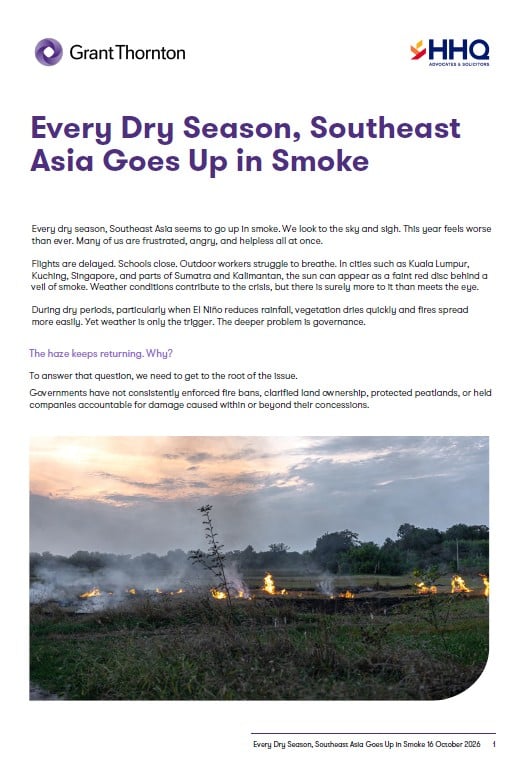
Every Dry Season, Southeast Asia Goes Up in Smoke
Should your organisation be interested in addressing the complexities discussed here, do reach out to us to find out how we can help you tackle challenges and take advantage of new opportunities.
Authors
-

Dr. Hema Surendranathan
Dr. Hema Surendranathan is the Director of Sustainability & Climate Change of Grant Thornton Malaysia and is dedicated to delivering professional advice and services to all clients.View Profile -

Cynthia Gabriel
Partner Head of ESG Practice Group & Regulatory Compliance Halim, Hong & Quek