
TheStar: Merit matters for women too
As published in TheStar, 14th March 2026
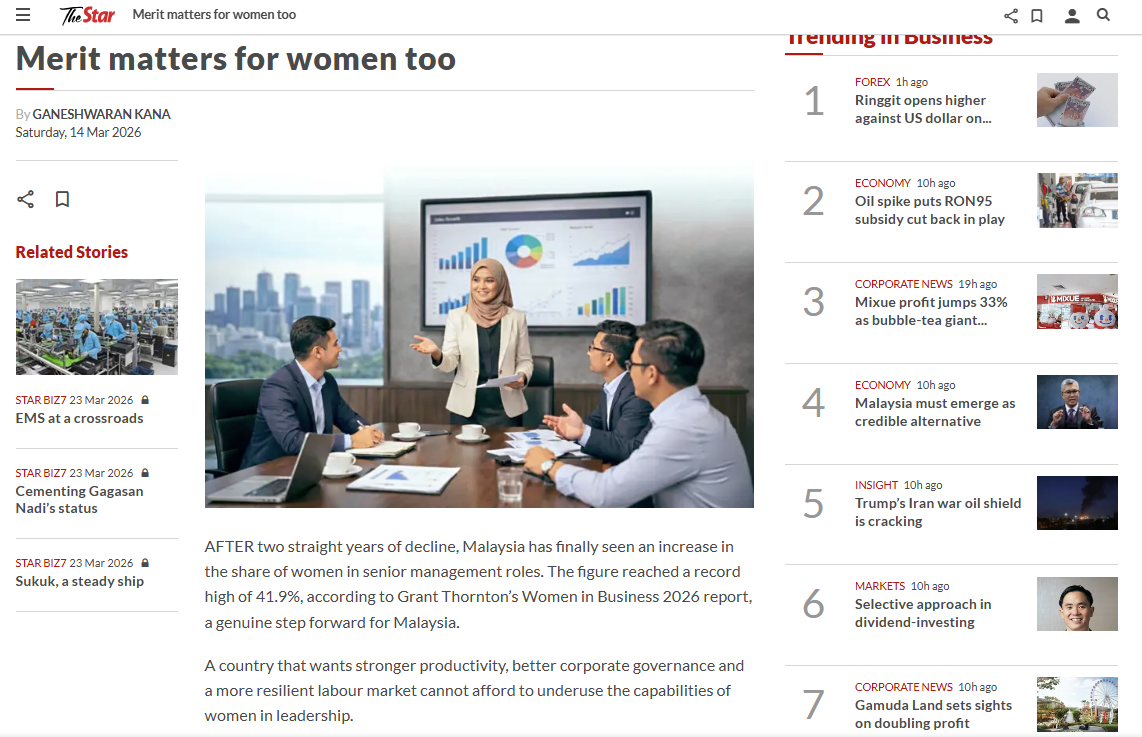
AFTER two straight years of decline, Malaysia has finally seen an increase in the share of women in senior management roles. The figure reached a record high of 41.9%, according to Grant Thornton’s Women in Business 2026 report, a genuine step forward for Malaysia.
A country that wants stronger productivity, better corporate governance and a more resilient labour market cannot afford to underuse the capabilities of women in leadership.
The latest figures suggest the private sector is beginning to understand this more clearly.
More women are getting into senior management, fewer firms are operating without any female presence at the top, and investors as well as job candidates are paying closer attention to whether companies are serious about gender balance.
The numbers are encouraging. The proportion of Malaysian businesses with no women in senior management has more than halved, dropping to 4.5% in 2026 from 9.3% in 2025.
Women also remain strongly represented in important functions. Some 57.3% of women in senior management are in human resources, up from 48.3% a year earlier.
Another 48.3% hold chief finance officer roles, slightly higher than 47.2% in 2025. More notably, 32.6% are in chief commercial officer roles, up from 25.8%.
These figures suggest progress is no longer confined to support functions. Instead, more women are moving into commercially important and financially strategic positions.
That matters because real influence in business is not measured by headcount alone.
It is measured by who makes decisions on capital, revenue, growth and risk.
It is not just a diversity story. It is a business story.
Grant Thornton’s findings reinforce this point. Gender equality is influencing recruitment decisions and investment interest.
Still, one uncomfortable truth remains. The private sector is making progress faster than public institutions.
If Malaysia is serious about women’s participation in the workforce, there should also be stronger female representation in the senior civil service, in Cabinet and in Parliament.
The current gap is glaring. In Dewan Rakyat, there are only 30 female representatives in the 222 seats. In the Cabinet, there are five female ministers out of 32.
While senior women in the corporate world are becoming more visible, the same cannot be said of the upper layers of public administration or political leadership.
This matters because decisions on budgets, regulation, social policy, childcare, education and labour participation are shaped heavily by those in public office.
A country cannot fully harness the benefits of women in the workforce if women remain underrepresented in the institutions that shape national priorities.
Therein lies the challenge to Putrajaya and to political parties.
Female representation cannot be celebrated when it looks good only in annual reports and sustainability disclosures.
This issue needs to be discussed with more honesty and less moral posturing.
Most reasonable people want to see more women breaking the glass ceiling because they are capable and deserving.
Yet it is also understandable why quota-based mechanisms or mandatory governance expectations have been introduced.
Resistance exists. Old habits in hiring and promotion exist. Old boys’ networks tend to reproduce themselves. In that environment, some form of external push can be useful.
Malaysia’s boardroom framework reflects this reality. Listed issuers are required to have at least one woman director on the board.
Separately, the 30% threshold for women directors under the Malaysian Code on Corporate Governance has become an important benchmark, even if it is not a law in the strictest sense for every public listed company.
Companies that fall short can face reputational pressure, especially when they have to explain why they did not adopt the recommended practice and what alternative approach they are taking.
Quota systems and disclosure requirements can help correct entrenched imbalance. But they should not exist indefinitely as permanent crutches.
If left unchecked for too long, they can become destructive. A policy that begins as a corrective tool can end up encouraging compliance for optics rather than genuine talent development.
Companies may start filling seats simply to avoid looking bad to investors instead of building a strong and credible pipeline of women leaders.
This is where the conversation becomes more difficult, but also more important.
A business should not be pushed into making leadership choices that weaken meritocracy.
If a firm has five senior leadership roles and the strongest available candidates at a given point happen to be men, should it alter its course mainly because of investor pressure over gender optics?
It’s not a comfortable question, but it is a legitimate one.
Leadership appointments affect strategy, execution and productivity.
A forced outcome that ignores capability can carry real business costs. A mature diversity agenda must recognise this tension.
The aim should not be to reduce the number of men simply to improve a ratio.
The aim should be to ensure that capable women are not blocked from rising because of bias, weak promotion structures or institutional inertia. There is an important difference there.
For that reason, the most sustainable path is not endless pressure from above. It is stronger pipeline building from within.
Companies should focus on retention, progression, sponsorship and succession planning so that more women are naturally ready for senior roles.
Progress that comes through capability, preparation and fair exposure will always be stronger than progress driven mainly by reporting pressure.
Malaysia also needs to be more honest about the wider diversity, equity, and inclusion (DEI) conversation.
In many workplaces, including government-linked companies, DEI remains half baked. The emphasis is often heavily gender-centric, and by gender it usually means women.
Far less attention is paid to other questions of inclusiveness, including racial representation and broader workplace fairness.
This selective approach weakens credibility. A serious DEI framework cannot be driven only by what is visible, fashionable or investor friendly.
Women make up about half of Malaysia’s population. Strong representation at work is therefore not only fair but necessary.
Still, the country should be careful not to turn a valid cause into a hollow exercise.
Representation matters, but merit matters too.
The right objective is not to appoint women merely to fill a gap, satisfy investor expectations or produce better DEI optics.
The right objective is to ensure that the best women rise, without artificial barriers in the way.
Malaysia is moving in the right direction. The challenge now is to keep the progress real, balanced and sustainable.