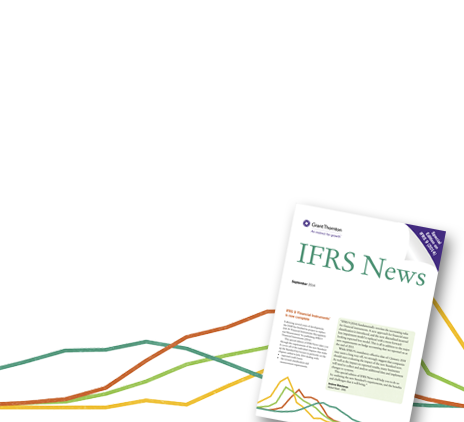
IFRS 9 fundamentally rewrites the accounting rules for financial instruments, introducing a new approach for financial asset classification and replacing the now discredited incurred loss impairment model with a more forward-looking expected loss model. All in addition to the major new requirements on hedge accounting that we reported on at the end of 2013. This special edition of IFRS News outlines the new Standard’s requirements, and the benefits and challenges that it will bring.

Filter insights by:
Showing 15 of 79 content results
This special edition of MFRS Hot Topics explains the key features of the new Standard and provides practical insights into its application and impact.
Grant Thornton looks at the potential impact of IFRS 15 'Revenue from Contracts with Customers' for revenue recognition in the real estate industry.
Grant Thornton looks at the potential impact of IFRS 15 'Revenue from Contracts with Customers' for revenue recognition in the construction industry.
Grant Thornton looks at the potential impact of IFRS 15 'Revenue from Contracts with Customers' for revenue recognition in the manufacturing industry.
Grant Thornton looks at the potential impact of IFRS 15 'Revenue from Contracts with Customers' for revenue recognition in the retail industry.
Grant Thornton looks at the potential impact of IFRS 15 'Revenue from Contracts with Customers' for revenue recognition in the software and cloud services industries.
The IASB has published IFRS 15 ‘Revenue from Contracts with Customers’.
This issue provides guidance on cost of an investment in a subsidiary in separate financial statements.
This issue provides guidance on consolidated financial statements when an entity ceases to be a parent entity.
This issue provides guidance on the effect of events after the reporting period on valuation, impairment and existence of financial assets.
This publication guides management through the top 20 disclosure and accounting issues identified by Grant Thornton as potential challenges for IFRS preparers.
IAS 39 ‘Financial Instruments: Recognition and Measurement’, the previous Standard that dealt with hedge accounting, was heavily criticised for containing complex rules which either made it impossible for entities to use hedge accounting or, in some cases, simply put them off doing so.
Many companies find the accounting for deferred tax causes significant practical difficulties. This guide summarises the approach required by IAS 12 'Income Taxes' and provides examples of the disclosures required by it. It also looks in detail at some of the more complex areas of preparation of a deferred tax computation, for example the calculation of deferred tax balances arising from business combinations.
Increasing attention on companies’ cash generation and liquidity position has led financial statement users, regulators and other commentators to focus increasingly on the Statement of Cash Flows. However, this additional focus and scrutiny has also highlighted some common errors and inconsistencies in its preparation. This Guide aims to remind management of IAS 7's basic requirements; highlight interpretative and practical application issues; and provide insights to address these issues.